
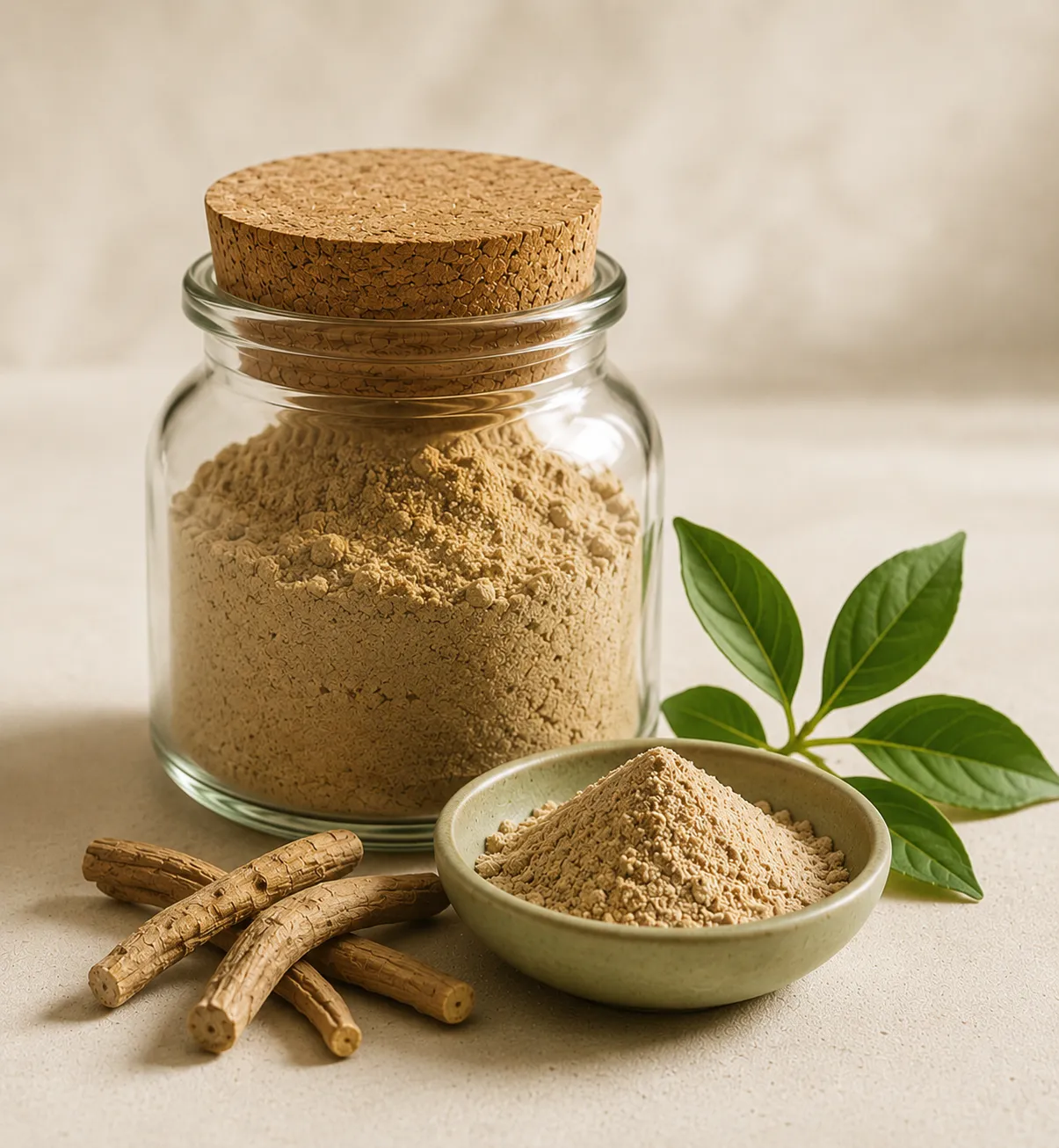
Shatavari means "she who has a hundred husbands" — a name that speaks to the plant's reputation for supporting the female body through every stage of its life. From menarche to menopause, in classical Ayurvedic texts, Shatavari is the primary rasayana for women.
It is also the herb on which Ovanav was built.
What the plant is
Asparagus racemosus is a climbing plant found across India and the Himalayas. The part used medicinally is the root — specifically, the fleshy tuberous roots that look like a bundle of small sweet potatoes. These are dried, powdered, and used directly, or processed into ghee or milk decoctions according to classical methods.
The taste is sweet and bitter. The energy is cooling. The post-digestive effect is sweet. In Ayurvedic pharmacology, this combination makes Shatavari deeply nourishing without being heating — a rare quality in a tonic herb.
What the research says
Shatavari contains a group of steroidal saponins called shatavarins, along with isoflavones and polysaccharides. The shatavarins are the primary active constituents and have been studied for their effects on reproductive hormone regulation, galactagogue activity (supporting milk production), and adaptogenic properties.
Clinical trials have shown Shatavari extract to be effective in supporting follicular development, reducing menstrual irregularity, and improving endometrial thickness in women with PCOS. The mechanism appears to involve modulation of FSH and LH levels — the hormones that govern the ovarian cycle.
Why it is the foundation, not an add-on
When I formulated Ovanav, the decision to make Shatavari 60% of the formula — 300 mg out of 500 mg per capsule — was deliberate. Many herbal women's health products spread their ingredients thinly across a dozen herbs. The result is that no single herb reaches a therapeutic dose.
Shatavari needs to be present at 300–500 mg per day, taken consistently over three to four cycles, before its nourishing effect on rasa and rakta dhatu becomes measurable. Lower doses produce inconsistent results. This is why I chose depth over breadth in the formulation.
The supporting herbs
The remaining 40% of Ovanav is Ashoka bark, Lodhra bark, and Ashwagandha — each chosen for a specific function. Ashoka is the classical uterine tonic, used for centuries in conditions affecting the endometrium and menstrual flow. Lodhra is astringent and useful where there is excessive discharge or irregular bleeding. Ashwagandha is the adaptogen that steadies the stress-hormone axis, because elevated cortisol is one of the most common upstream causes of disrupted ovarian function in the women I see.
Together, they address the tissue nourishment (Shatavari), the uterine environment (Ashoka, Lodhra), and the nervous system layer (Ashwagandha) — three of the four factors I consistently find disrupted in women with irregular cycles.
How to take it
The classical method is with warm milk, morning and evening, taken consistently for ninety days before expecting significant change. This is not a supplement you feel in the first week. Rasayana herbs build slowly, at the level of tissue — which is exactly why their effect lasts.