
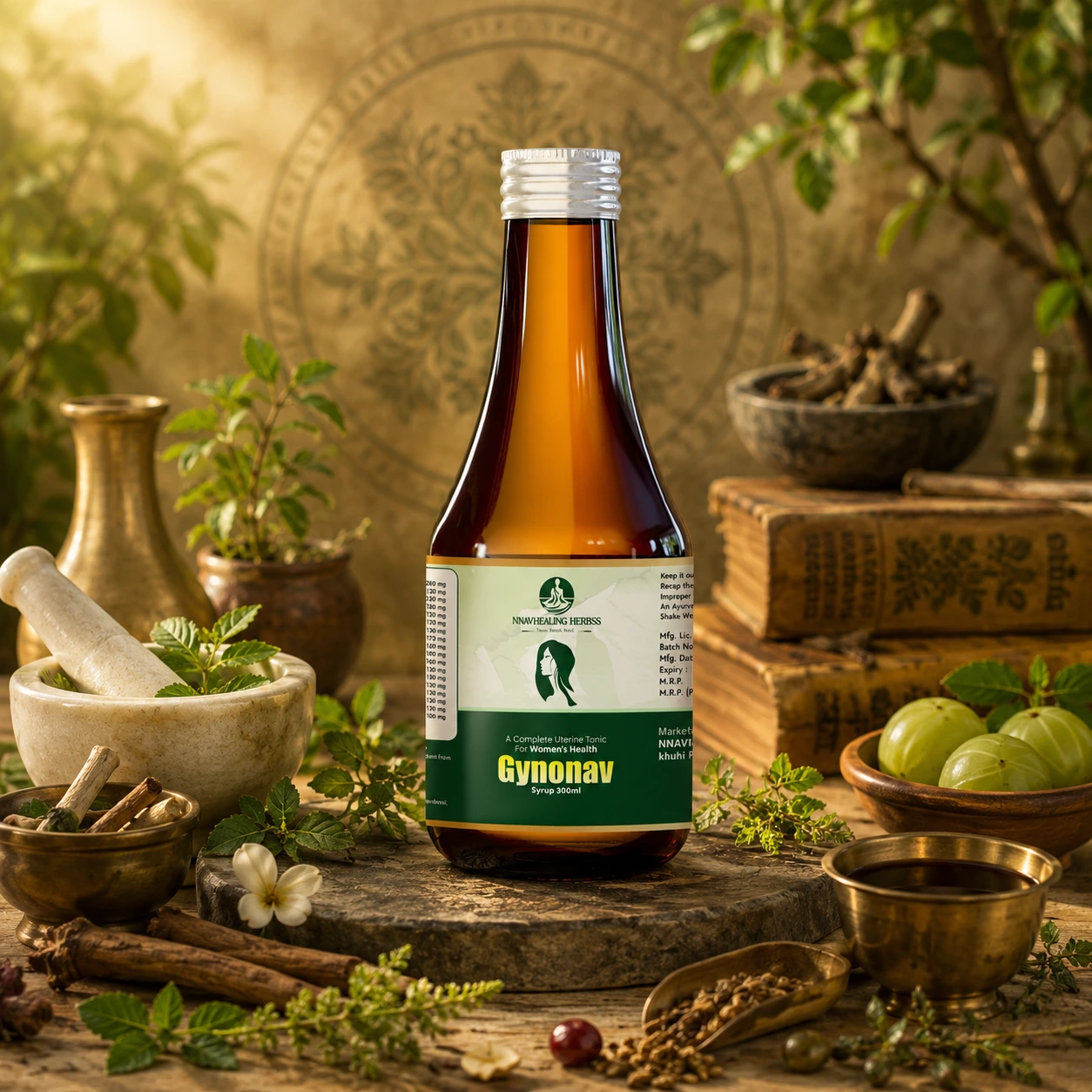
The most common question I receive about Gynonav is: why a syrup? Why not capsules, which are easier to carry, easier to dose, and easier to take with a glass of water?
The answer requires a short explanation of how Ayurvedic pharmacology thinks about the relationship between form and function.
Why form matters
In classical Ayurveda, the vehicle (anupana) and the form of a preparation are not cosmetic decisions. They affect how, where, and how quickly a formula reaches the target tissue.
For conditions affecting rasa dhatu (plasma and lymph) and rakta dhatu (blood), the classical preparation is liquid — an asava, arishta, or sweetened decoction. The liquid form is absorbed more rapidly into the plasma and transported into the blood before it reaches the gut for further digestion. A capsule, by contrast, must first be dissolved in the stomach and then absorbed through the intestinal mucosa — a longer and less direct route to the bloodstream.
For a formula specifically targeting blood and strength — as Gynonav does — the syrup form is not a convenience choice. It is the classical choice, because it works faster and more directly on the tissue it is trying to nourish.
Draksha — the primary base
Vitis vinifera — raisin — is the principal vehicle and active ingredient of Gynonav. In Ayurveda, Draksha is one of the ten most important medicinal fruits, classified as nourishing, unctuous, and deeply supportive of rasa and rakta dhatu.
Its sweetness carries the formula into the plasma. Its mildly sour quality supports the liver (a critical organ in blood production and hormone clearance). Its cooling energy prevents the iron-supplementation problem common in Ayurvedic mineral preparations — the tendency to create heat and inflammation in the body.
Lohabhasma — purified iron ash
This is the ingredient that raises the most questions. Lohabhasma is iron that has been through a classical purification process (shodhana) and calcination process (marana) — reduced to an extremely fine ash that is, in Ayurvedic pharmacology, more bioavailable and less heating than raw iron supplementation.
Modern research on bhasma preparations suggests that the particle size of classically prepared Lohabhasma is in the nanometre range — smaller than most pharmaceutical iron preparations — which supports the Ayurvedic claim of superior absorption. At the same time, the purification process removes the compounds that typically cause the constipation and gut irritation associated with iron supplements.
In women with low ferritin, fatigue, and blood depletion following heavy periods, Lohabhasma in a Draksha base is the most effective preparation I have used — faster in its effect on energy than conventional supplementation, and without the digestive side effects.
Ashoka and Amla in support
Ashoka in Gynonav serves the same function as in Ovanav — uterine tone and cycle support — but at a supporting dose, because Gynonav's primary focus is on blood and strength rather than cycle regulation.
Amla (Phyllanthus emblica) is the anupana that ties the formula together. It is both an iron-absorption enhancer (its vitamin C content is among the highest of any natural source) and a rasayana that protects rasa dhatu from the oxidative load that comes with aggressive mineral supplementation.
When to use Gynonav alongside Ovanav
The two formulations are frequently paired in my practice. Ovanav handles the hormonal and cycle-regulatory work. Gynonav handles the blood-building and strength work. For women who are both cycle-irregular and fatigued — a very common presentation — taking both simultaneously produces faster and more comprehensive results than either alone.
The typical combination is Ovanav morning and evening, and Gynonav 10 ml once daily after lunch. After 60 days, energy improvements are usually measurable. After 90 days, cycle changes from Ovanav begin to stabilise on a stronger base of nourishment.